
We Tested How ChatGPT, Gemini, Perplexity, and Claude Recommend Luxury Resorts. Here Is What We Found.
By Hans Lagerweij
We Tested How ChatGPT, Gemini, Perplexity, and Claude Recommend Luxury Resorts. Here Is What We Found.
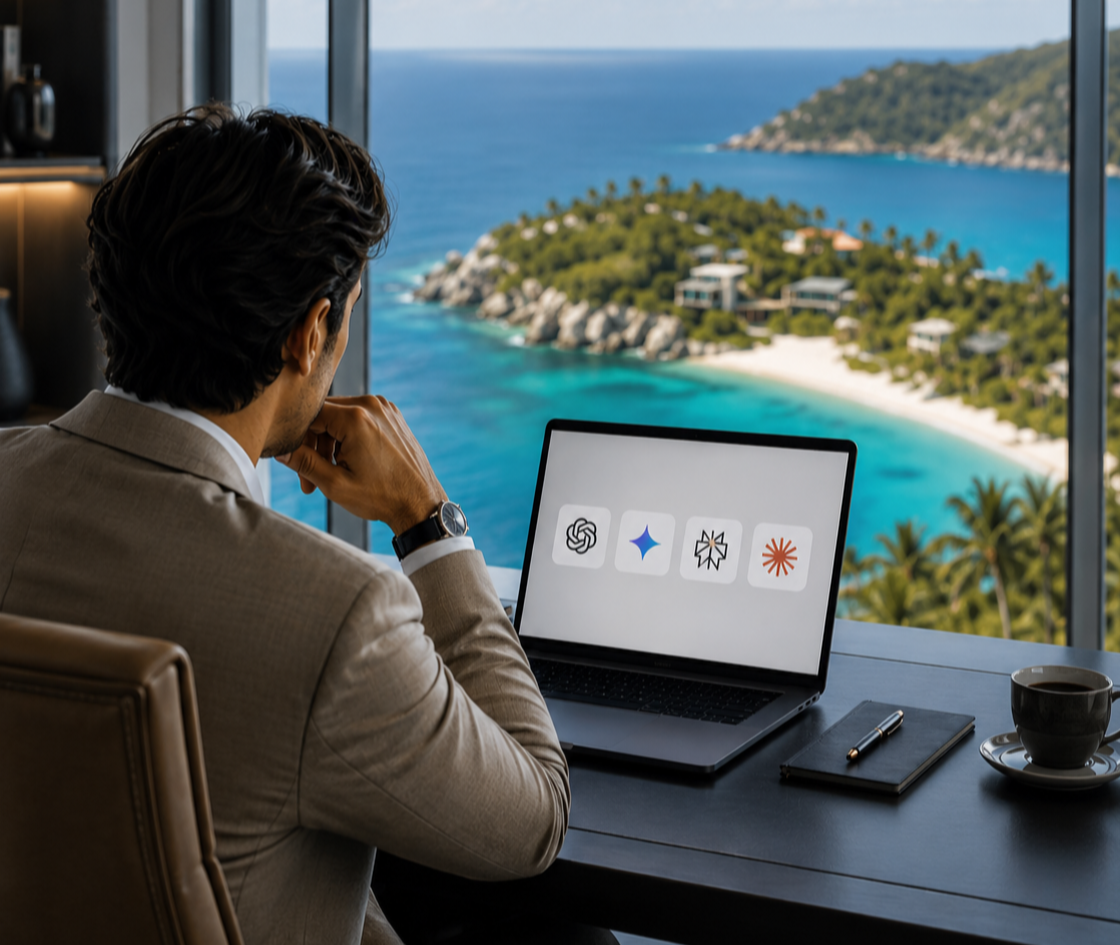
A few weeks ago, I did a poll on LinkedIn asking what digital marketing topic we should tackle next. Turns out the majority (70%) of you feel that theoretical background or platform-specific strategies are less interesting than actual business case deep dives with practical recommendations. So, we developed one! In the shoes of family office concierges, personal assistants and wealthy travelers, we tested prompts in ChatGPT, Google Gemini, Perplexity, and Claude, uncovering which luxury travel brands these AIs would recommend to their clients, if any.
The Problem: Traditional SEO Fails on AI Search Engines
Today, when a wealthy traveler is planning a journey, they seldom use Google to look up simple queries such as 'luxury resorts in the Caribbean' since this leads to millions of crowded online travel operator listings and sponsored advertisements. Rather, they enter detailed and very specific requests directly into conversational AI services, asking for three private island resorts in the Caribbean which have a private airstrip, top-quality physical security, and full buyout possibilities for a family retreat. In our tests of such queries across a number of luxury travel sectors, fewer than 15% of the world's top boutique resorts and private safari camps were named. The AI did not overlook them because of their lack of prestige; it failed to mention them because their websites were designed for static human browsing and not for dynamic AI retrieval.
The Playbook: 3 Steps to Getting Recommended by AI
In order for AI platforms to include your property, you'll have to change the way in which you organize and publish your brand's digital presence.
1. Use the Live Video Discovery and AI Integration platforms
Today’s AIs are not simply reading static webpages; they’re also analyzing live video. For example, platforms like Atmosfy[1], the live video mapping service that's integrated with ChatGPT and Google Gemini, can enable these AIs to "see" real-world venues and facilities. By feeding unaltered, up-to-the-minute video content into platforms that are connected to AI engines, large language models are given verified metadata (such as information on the use of private helipads, the layout of beachfront areas, or the condition of private villas) which cannot be obtained through textual claims. This serves as 'visual proof'. When an UHNW guest asks for real-time context, the AI turns to live video feeds and location & layout data to check its answer."
2. Present your team as experts who are real with verifiable expertise.
AI tools are skeptical of vague (also sometimes called “BS”) brand statements. For example, if your website just says, "we offer world-class privacy", the AI will generally ignore it; however, if a named and verified expert endorses it, the AI will take notice. We therefore strongly recommend providing dedicated bio pages for your leadership team, including the General Manager, Chef, Security Manager, etc. On these pages make sure to emphasize their qualifications, background, and accomplishments. After that, you need to create and share content that will help in the indexing process. Ask these executives to write articles or provide press quotes on specific topics such as high-security travel arrangements or multi-generational estate buyouts. Whenever AI systems search for reliable sources on these subjects, they will then link those individuals directly to your brand.
3. Establish your authority through third-party 'trust connections'.
AI models do not merely read your website; they compare it with the wider web to check the accuracy of your statements. Start with the technical metadata — structured factual data listing the key needs for wealthy clients: runway length, private dockage, security perimeter, staff-to-guest ratio. Just as is the case in the conventional marketing industry, publicity, mentions and inbound links by industry sources remain important, maybe more so than ever. Publication in reputable channels such as Robb Report, Condé Nast Traveler, or luxury network directories serves as a strong indication to AI. When search engines such as Perplexity or Gemini crawl a list of the top private estates featured in those publications, they rank your resort within that same elite category.
Conclusion
Wealthy travelers and their respective teams are currently using AI as an interim concierge. It's no longer necessary to spend money on expensive Google ads or aim for a high volume of web traffic if you want to win their business—instead, you should use direct AI video feeds, structured expert data, and third-party authority so that AI systems will regard your property as the obvious and trustworthy answer.
Hans, originally from the Netherlands, holds an MBA from Erasmus University Rotterdam and an MA in Brand Management. His early career foundation was built in brand activation, development, and sales roles within the packaged consumer goods industry. He then transitioned to the travel and tourism sector, where he has a proven track record of leading, turning-around and growing businesses. His experience includes CEO and President roles at Quark Expeditions and Victory Cruise Lines as well as leading international businesses for Albatros Travel and serving as a Senior Vice President at Four Seasons. Hans now leads Flying Dutchman Consultancy, focusing on growth strategies. He is also a Non-Executive Director of ClickCore Strategies and a board advisor for several startups. His book “The Why Whisperer, how to motivate and align teams that get your strategy done” was released in May 2025